John Tung on curating SEA Focus and the artistic sentiments in the region now.
- Sarah Wei

- Feb 6
- 10 min read
Updated: Feb 10

When John Tung talks about curating, he begins with a toolbox, a literal one. Fresh from the close of the 2026 edition of SEA Focus at ART SG, Tung has a get your hands dirty attitude to exhibiting. “We had a really strong response,” he says. “[feedback was] very positive from most of the visitors… I’m very happy with how it turned out.” Behind the fair's success lies a philosophy of exhibition-making that is far removed from the glamorous stereotype of the jet-setting curator.
“People imagine stylish outfits and opening nights,” he jokes. “But I’m a hands-on curator. Behind me right now are toolboxes and scaffolding. My hands are beaten up and I am wearing workwear.” For Tung, the word “curate” returns to its Latin root, curare — to care. “Are you a parent? If you have never changed a diaper, I've said, is my approach to curating… There’s blood and sweat behind them — hopefully not tears.”
Read on for our full interview Q+A covering SEA Focus, ART SG, curating, and cultural capital in the region, expectations, and more.
On SEA Focus moving into ART SG
Sarah: Previously SEA Focus was in a separate location, and now it’s inside the fair. How did that change the way you curated the show? SEA Focus has often been described as more of a museum-like experience than a typical fair booth.
John Tung: That museum-like quality has really been part of SEA Focus’s identity for many years, especially since it moved to Tanjong Pagar District Park about five or six years ago. SEA Focus is a curated platform, so the experience is always closer to going to a museum than visiting a typical art fair booth.
I’ve had the pleasure of creating three editions — two at Tanjong Pagar Distripark and this most recent one at ART SG. Each edition aims to create a very different visitor experience from the previous one.
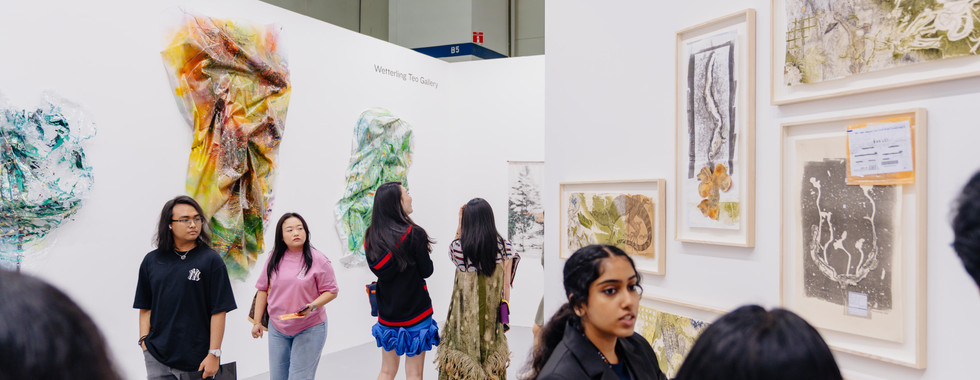
The approach stayed largely the same, but the venue made a difference. A convention hall is a tabula rasa — a blank slate. It gives you a lot of freedom to build walls exactly the way you want. In the previous venue, we had columns and architectural features we had to work around. Having a blank slate gives more opportunities to exercise creativity.
For this edition, we centralised X-shaped walls, which became quite iconic, and in previous editions, we modelled the “islands” of the layout to resemble the archipelagos of Southeast Asia. A lot of effort goes into the selection of galleries and artists, considering geographic representation, gender representation, and where artists sit in terms of market presence. The experience is always carefully curated.




Sarah: How do you think this curatorial platform helps bring in smaller galleries?
John: The galleries are actually a very diverse mix. They’re not necessarily all small galleries. Yes, you have new and emerging galleries, but you also have international powerhouses that have participated in numerous editions of SEA Focus as well.
The unique thing about SEA Focus is that it’s an opportunity for artworks and artists to be contextualised among peers who are practicing in the region. Whether they’re established or emerging, they’re working within the same epoch. Their concerns are aligned; they’re living in the same zeitgeist.
That’s the greatest value SEA Focus brings. Unlike a typical fair, where each gallery has its own objectives and commercial interests, here everything converges under a singular kind of territorial and conceptual banner. I think we’re starting to see that there is value in seeing connections and contextualising works, rather than just seeing them as individual commercial presentations.
I thought it was really interesting that with the new Art Basel in Qatar [which opened from February 5–7, 2026], they’ve actually adopted a very similar approach — each booth is supposed to present one artist, they’re all thoroughly screened, and they’re expected to unite under that same singular banner. So this idea of having a curated experience — not purely a fair — we’re starting to see that there’s value in seeing the connections and contextualising the work as well.
What collectors bought at SEA Focus and ART SG 2026
Sarah: What were some of the most popular themes or works with collectors? Or even some surprise sleeper hits?
John: [He jokes] I’m a horrible person to ask because I have got such a close working relationship in the realisation of the show. So every work always stands out to me as really unique and really special.
There was strong support for many of the young artists. Inez Katamso, for example, did very, very well, which shows collectors are very interested in a younger generation of artists.
A group of young artists presented by Mr Lim's Shop of Visual Treasures also saw almost all the works picked up by collectors. But then again, on the other end of the spectrum, a new installation by Robert Zhao was one of the first works acquired during the preview days. So, collector interest remains very broad in Singapore. People are looking at works across a great variety of price points, and SEA Focus is able to provide that range, from recent graduates and newly emerging artists to very established historical figures.


Cultural capital in Singapore, the region, and the artist sentiments behind it
Sarah: Do you think Southeast Asian artists are under pressure to explain their region to the world?
John: I wouldn’t put it as pressure, but there is definitely awareness of how the international art world wants to frame Southeast Asia, and sometimes there’s active resistance against that. [On the platform Something Curated] I wrote an article recently about this notion of Southeast Asia being “up-and-coming.” Up-and-coming benchmarked against what? Are we talking about sales, infrastructure? Western models are still predominant in those conversations.
Art doesn’t operate like Keynesian economics. In that regard, I think Southeast Asia remains very, very true to themselves. It provides a supply for a demand that doesn’t exist yet. Southeast Asian artists remain very true to themselves. They respond to issues they’ve engaged with for a long time, drawing on distinct and hybridised histories. There’s still very strong cognisance of the postcolonial nature of Southeast Asia’s existence, and that manifests quite clearly in the work.
Sarah: Singapore is positioning itself as a regional cultural capital — what does Singapore enable that other cities don’t, and why?
John: My academic background is not in curating — it’s in cultural policy. I wrote my master’s thesis on the evolution of Singapore’s cultural policy. The notion of being a cultural capital is not new, and Singapore’s model draws from quite a variety of global sources.Even the United States' Cold War policies come to mind, with the CIA funding abstract expressionist exhibitions abroad as a means of soft power. Singapore isn’t at war with anyone, but there is definitely a desire to be seen as a gateway to Southeast Asia.
SEA Focus allows people to see some of the best and most recent offerings from across the region in one destination, instead of flying to eleven different countries, to tease it out, to do the excavation, bit by bit. Singapore is leveraging on a lot of its strengths, its history of strong bilateral ties with our neighbours in the region, and the confidence that our neighbours have in Singapore to be able to accurately represent and reflect the variety of tastes, beliefs, and opinions of the different peoples of Southeast Asia.
That being said, I think it’s also a really heavy burden to bear, the burden of representation, right? So I think, for Singapore, as a commissioner for many of these events, the best they can do is find individuals who take this sort of responsibility seriously. And I would like to think I take this responsibility seriously.

The growth of private museums in Southeast Asia
Sarah: Shifting to the art scenes more broadly. How do you think the art scenes in other major Southeast Asian cities are changing?
John: Across Southeast Asia, particularly in the more developed cultural production centres like Jakarta, Bangkok, and Kuala Lumpur, we’re seeing a rise in private museums being opened. MAIIAM opened fairly recently in Bangkok, and there’s MACAN in Jakarta.
In Singapore, that trend isn’t manifesting at quite the same scale as in the region. Such as The Private Museum by the Teo Family. There’s also an influx of collector-established art spaces. So I do think that across the region, patrons and benefactors of the arts are really putting their resources where their mouths are, creating infrastructure that runs parallel to state-funded spaces. That’s helping to build a more diverse and vibrant ecosystem overall.
Sarah: What do you think about collectors opening private museums?
John: I recall the establishment of MAIIAM in Thailand, which is the project of a really notable collector, Eric Bunnag Booth. His rationale for establishing MAIIAM was quite straightforward. At that point in time, there wasn’t a permanent collection-based institution or museum in Thailand showing Thai art. He very much wanted Thai people — young artists, young students — to have the opportunity to see iconic works of Thai art in Thailand itself.
Singapore was the regional powerhouse in collecting at the time, but he wanted a place where local countrymen could encounter their own art history. I wholeheartedly believe in the purity of his intentions and vision in establishing MAIIAM, and I think MAIIAM has really been a beacon in the region for how a private museum can be established, run, and operated.
The space I am currently associated with, Project Art Hunter, was established by another notable Singaporean collector, Yeap Lam Yang. It’s nowhere near the scale of MAIIAM — it’s a relatively small space, about 1,600 square feet. Over the next couple of years, he plans to present a series of rotating exhibitions drawn from his own collection. At the same time, he’s also a well-known patron of the National Gallery Singapore and the Singapore Art Museum, having donated more than 100 works to these institutions.
But we need to be cognisant that not all works in a private collection fit well into an institutional context. Collecting institutions have their own acquisition strategies. Just because a collector wants to donate a work doesn’t mean the museum will accept it, if it doesn’t align with their particular strategy. So that leaves many works residing in private collections with limited avenues for public presentation, unless collectors establish their own spaces.
For a private collector, their strategy does not have to align with institutional goals. They don’t need to chronicle art history in a structured way. Ultimately, private collections reflect tastes and sensibilities. As much as we want to prioritise academic research and art historical frameworks, we shouldn’t forget that one of the biggest catalysts for the development of art over the last 600 years has been connoisseurship. That is what private collections represent. Being able to see and experience the works and collecting preferences of these individuals is valuable. Not just for people who can afford to collect, but also for those who haven’t started collecting or cannot afford to collect as well.
Quick Fire: The reality of curating, how and why, and what’s next for John
Sarah: What do you think is one of the most misunderstood things about curating — and the part that’s not glamorous at all?
John: If you just Google “typical curator,” even myself, right, it’s someone in a funky outfit or a business suit, looking glamorous at an opening. But there are many different types of curators, and I’m very much a “get my hands dirty” kind of curator.
I’m a strong believer that curatorship comes from the Latin word curare, which means “to care.” And care manifests in many ways. Are you a parent? If you have never changed a diaper, I've said, is my approach to curating. What doesn’t get captured in press photos — outside of the fancy outfits — is that there’s a lot of blood and sweat, hopefully not tears, that go into the execution of an exhibition. My hands are literally the most beat-up things in the world right now after Singapore Art Week. It’s going to take a while to recover. But it’s the dirty side of the job that I think makes me love it the most.

Sarah: What do you want visitors to feel as they leave one of your shows? What questions do you hope they walk away with?
John: I think sometimes curating today is seen as this very abstract, theoretical, almost sexy thing — exploring material sensibilities, territorial ideas, all these conceptual frameworks. But at the end of the day, I’m still quite old-fashioned in that sense.
"With pretty much every exhibition I work on, I always ask myself: what is the moral of the story? What should a visitor be walking away feeling?"
In its recent edition, SEA Focus, for example, looked at violence perpetrated against people, the ecological crisis, and displacement. I want people to think more deeply about how well we’ve been doing as stewards of this planet. And frankly, we’re doing horribly, as far as I’m concerned.
So when people go into my exhibitions, I want them to think about the issues I’m raising, which I sometimes put quite explicitly in the curatorial statements. My approach to curating an exhibition is actually the delivery of policy, but in a democratic way. If we think of policy as a form of social engineering, the state might have legislation, schools might have rules, and you’re obliged to follow them. But with an exhibition, you can consider my propositions. You can decide whether you want to buy into that set of beliefs or not. To me, that’s a very democratic way of delivering policy.
Sarah: And last question — what do you have coming up this year, and what are you most excited about?
John: I am opening an exhibition tomorrow night called Homecoming. It’s the third edition of a suite of shows I do annually with a good artist friend of mine, Kim Whye Kee.
For this upcoming edition, I am really excited because, beyond Kim himself, we have a collaborator who’s also presenting, Royston Tan, the acclaimed director of 881 and many prominent works in local cinema. For the first time in 14 years, he’ll be presenting a new video installation. It consists of documentary footage of 100 families in Singapore having dinner.
So the exhibition is a rumination on home and the rituals of eating, families coming together at the dining table, and a deliberation on what the notion of home, or coming home, really means. That opens tomorrow night [7th February 2026].
Follow curator John Tung and his upcoming exhibitions, including Homecoming and future projects with SEA Focus and Project Art Hunter, as he pushes conversations around Southeast Asian art, cultural policy, and exhibition-making across the region.
[All Images Courtesy of Sutton Communications]


